
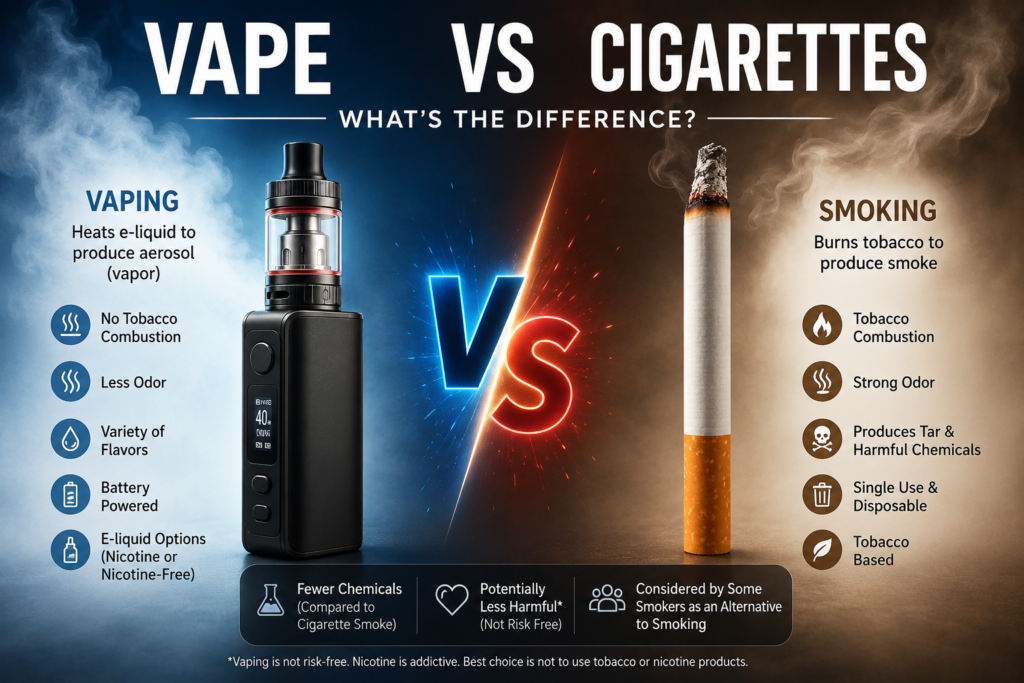
Vape vs Cigarettes: What’s the Difference?
Vape vs Cigarettes: What’s the Difference? Vaping and smoking cigarettes are often compared because both involve inhaling substances into the lungs and, in many cases, delivering nicotine. However, the two products work in very different ways and expose users to different substances.
If you are trying to understand the difference between vaping and traditional cigarettes, it helps to look beyond the device or smoke itself. Ingredients, heating methods, nicotine delivery, emissions, smell, and health considerations all play a role.
This guide explains the key differences between vapes and cigarettes in straightforward terms so you can better understand how each works.
What Is the Difference Between Vaping and Smoking?
The biggest difference comes down to how the product is used.
A traditional cigarette burns tobacco. When a cigarette is lit, combustion produces smoke containing thousands of chemicals, including many substances that can damage health.
A vape device does not burn tobacco in the same way. Instead, it heats a liquid, commonly called e-liquid or vape juice, to create an aerosol that the user inhales.
This means vaping and smoking are not simply two versions of the same activity. They involve different products, processes, and chemical exposures.
How Do Cigarettes Work?
A cigarette generally contains cured tobacco wrapped in paper, along with other ingredients depending on the product.
When someone lights a cigarette, the tobacco burns. This combustion creates smoke that carries nicotine and numerous other chemicals into the lungs.
What Happens When Tobacco Burns?
Burning tobacco produces:
- Nicotine
- Carbon monoxide
- Tar
- Fine particles
- Numerous chemical compounds
- Toxic substances
- Carcinogenic compounds
Nicotine is the primary addictive substance in cigarettes, but it is not responsible for all of the harmful effects associated with smoking.
Much of the serious damage associated with cigarette smoking comes from the complex mixture of chemicals generated during tobacco combustion.
How Do Vapes Work?
Vape devices use a battery to power a heating element. The heating element warms e-liquid, producing an aerosol that can be inhaled.
Depending on the device and e-liquid, vape liquid may contain ingredients such as:
- Propylene glycol (PG)
- Vegetable glycerin (VG)
- Flavorings
- Nicotine, where included
Some products contain no nicotine, while others contain different nicotine concentrations.
What Is Vape Aerosol?
A common misconception is that vape devices produce harmless water vapor.
The visible cloud from a vape is actually an aerosol, not simply water vapor. It can contain nicotine and other substances depending on the product and how it is used.
Therefore, vaping should not automatically be considered harmless simply because there is no tobacco combustion.
Vape vs Cigarettes: Key Differences
The most important differences can be summarized by looking at how each product operates.
| Feature | Cigarettes | Vapes |
|---|---|---|
| Main material | Tobacco | E-liquid |
| Heating method | Burning/combustion | Heating |
| Produces smoke | Yes | No, produces aerosol |
| Nicotine | Usually present | May or may not be present |
| Battery required | No | Usually yes |
| Combustion | Yes | No tobacco combustion |
| Odor | Typically strong and persistent | Often varies by e-liquid |
| Refillable options | No | Available for many devices |
| Disposable options | Cigarettes are discarded after use | Disposable vape products exist |
The exact characteristics vary between vape products and cigarette brands, so individual products should always be checked.
Nicotine in Vapes vs Cigarettes
This is one of the most important similarities between many cigarettes and vape products.
Nicotine is highly addictive and can lead to dependence regardless of whether it comes from a cigarette or a vape.
However, nicotine delivery can differ considerably between products.
A cigarette generally delivers nicotine rapidly after inhalation. Vape nicotine delivery can depend on several factors, including:
- Nicotine concentration
- Device design
- Coil characteristics
- Power output
- Puff duration
- Frequency of use
- E-liquid formulation
Some modern vape products use nicotine salts, which can allow relatively high nicotine concentrations while producing a smoother-feeling inhalation than some traditional freebase nicotine formulations.
Cigarette Smoke vs Vape Aerosol
One of the most important distinctions is the difference between cigarette smoke and vape aerosol.
Cigarette Smoke
Cigarette smoke results from combustion. Burning tobacco creates a complex mixture of gases and particles.
Long-term cigarette smoking is strongly associated with serious diseases, including lung cancer, heart disease, stroke, and chronic obstructive pulmonary disease.
Vape Aerosol
Vape aerosol comes from heating e-liquid rather than burning tobacco.
That does not mean the aerosol is risk-free. Depending on the device, liquid, and usage conditions, aerosol can contain nicotine, flavoring chemicals, ultrafine particles, and other substances.
Researchers continue to study the short- and long-term effects of vaping.
Is Vaping Safer Than Smoking?
This question requires careful wording.
For adults who already smoke cigarettes, completely switching from cigarettes to vaping may reduce exposure to many harmful chemicals associated with tobacco combustion. However, vaping is not risk-free.
The distinction between relative risk and absolute safety matters.
Something can potentially be less harmful than smoking without being harmless.
For someone who does not smoke, starting to vape introduces unnecessary exposure to nicotine and other substances.
For smokers considering switching, it is important to avoid using both products indefinitely. Continued cigarette smoking maintains exposure to the toxic chemicals produced by combustion.
Dual Use: Smoking and Vaping Together
Some people use both cigarettes and vape products. This is sometimes called dual use.
Dual use does not necessarily provide the same potential benefits as completely stopping cigarette smoking.
If a person continues smoking cigarettes while also vaping, they remain exposed to cigarette smoke and its harmful combustion products.
For smokers who want to move away from cigarettes, completely replacing smoking rather than simply adding vaping may have different health implications.
Vaping and Smoking: The Health Considerations
Both smoking and vaping deserve careful consideration because neither is completely risk-free.
Health Risks of Smoking
Cigarette smoking has been extensively studied and is a major cause of preventable disease and premature death.
Smoking is linked to:
- Lung cancer
- Heart disease
- Stroke
- COPD
- Respiratory disease
- Several other cancers
- Reduced lung function
The evidence surrounding the health consequences of cigarette smoking is extensive.
Health Risks of Vaping
Vaping is newer than cigarette smoking, so researchers have less information about its very long-term effects.
Known concerns include:
- Nicotine dependence
- Exposure to potentially harmful chemicals
- Respiratory irritation
- Cardiovascular effects
- Exposure to contaminants from some products
The risks can vary depending on the device, e-liquid, nicotine concentration, manufacturing quality, and usage patterns.
What About Secondhand Exposure?
Cigarettes produce secondhand smoke, which exposes people nearby to chemicals released during combustion.
Vapes do not create traditional cigarette smoke, but they can release aerosol into the surrounding environment.
Because vape aerosol can contain nicotine and other substances, it should not automatically be treated as harmless to people nearby.
Using vape products around children, pregnant people, or individuals with respiratory sensitivities should be avoided.
Why Do Cigarettes Smell Stronger?
Cigarette smoke often leaves a distinctive and persistent odor because burning tobacco creates smoke particles and chemical compounds that can settle on clothing, furniture, walls, and other surfaces.
Vape aerosol usually has a different odor profile, largely influenced by the flavoring used in the e-liquid.
However, the absence of a strong cigarette-like smell does not mean vaping is completely free of environmental exposure.
Which One Is More Addictive?
Both products can be addictive when they contain nicotine.
The level of nicotine dependence can vary considerably between individuals and products.
Factors that influence nicotine exposure include:
- Nicotine concentration
- Frequency of use
- Inhalation patterns
- Product design
- Individual tolerance
Someone who regularly uses a high-nicotine vape can develop nicotine dependence just as someone who regularly smokes cigarettes can.
Vaping vs Smoking for People Who Don’t Use Nicotine
If you currently do not smoke or use nicotine, there is generally no health benefit to starting either habit.
Vaping should not be viewed as a harmless lifestyle product simply because it does not burn tobacco.
Similarly, cigarettes carry well-established health risks and are not a safe alternative to vaping.
The healthiest option for someone who does not use tobacco or nicotine is not to start.
Can Vaping Help Smokers Quit?
Some adults use vaping as part of an attempt to move away from cigarettes.
Research has examined whether e-cigarettes can help some adults stop smoking, and evidence suggests they may help certain smokers when used as a complete substitute for cigarettes. However, approaches and recommendations vary by country and health authority.
People who want to quit smoking can also consider established smoking-cessation options, including behavioral support and approved medications.
If quitting is your goal, speaking with a qualified healthcare professional can help you choose an approach appropriate for your situation.
Vape vs Cigarettes: Which Should You Choose?
There is no universal answer because the appropriate decision depends on the person and their current nicotine use.
A person who does not smoke should not start vaping.
For an adult who currently smokes, completely moving away from combustible cigarettes can reduce exposure to many harmful substances created by tobacco combustion. Vaping may be one option some smokers consider, but it still carries risks and maintains nicotine dependence when nicotine-containing products are used.
The key distinction is between switching completely and simply using both products.
Frequently Asked Questions
Is vaping the same as smoking?
No. Smoking burns tobacco and produces smoke, while vaping generally heats e-liquid to produce an aerosol. The two processes create different chemical exposures.
Are vapes safer than cigarettes?
Vaping is generally considered less harmful than smoking combustible cigarettes because it does not involve tobacco combustion, but it is not risk-free. Cigarette smoking has much stronger evidence linking it to severe long-term disease.
Do vapes contain nicotine?
Many vape products contain nicotine, but some are marketed without nicotine. Always check the product’s labeling and ingredients.
Is nicotine itself harmful?
Nicotine is highly addictive and can affect the cardiovascular system. It is particularly concerning for young people and during pregnancy.
Is cigarette smoke worse than vape aerosol?
Cigarette smoke contains a large number of toxic substances generated by burning tobacco. Vape aerosol can also contain potentially harmful substances, but the chemical exposure is generally different.
Can you vape and smoke at the same time?
Yes, some people engage in dual use, but continuing to smoke cigarettes means continued exposure to the harmful products of tobacco combustion.
Are disposable vapes different from cigarettes?
Yes. Disposable vapes use an electronic heating system and e-liquid, while cigarettes burn tobacco. Disposable vapes are still capable of delivering nicotine and are not risk-free.
Final Thoughts
The difference between vaping and smoking cigarettes comes down primarily to combustion.
Cigarettes burn tobacco and produce smoke containing thousands of chemicals, many of which contribute to smoking-related disease. Vapes heat e-liquid and produce an aerosol instead of tobacco smoke.
For adults who already smoke, completely replacing cigarettes with vaping may reduce exposure to many harmful chemicals associated with combustion. However, vaping still carries health risks, particularly when nicotine is involved.
For people who do not smoke, starting to vape is not a healthy choice. And for anyone trying to quit nicotine entirely, evidence-based cessation support can provide a safer path toward becoming nicotine-free.
Ultimately, understanding the differences between vapes and cigarettes can help consumers make more informed decisions about nicotine products and their potential risks.