
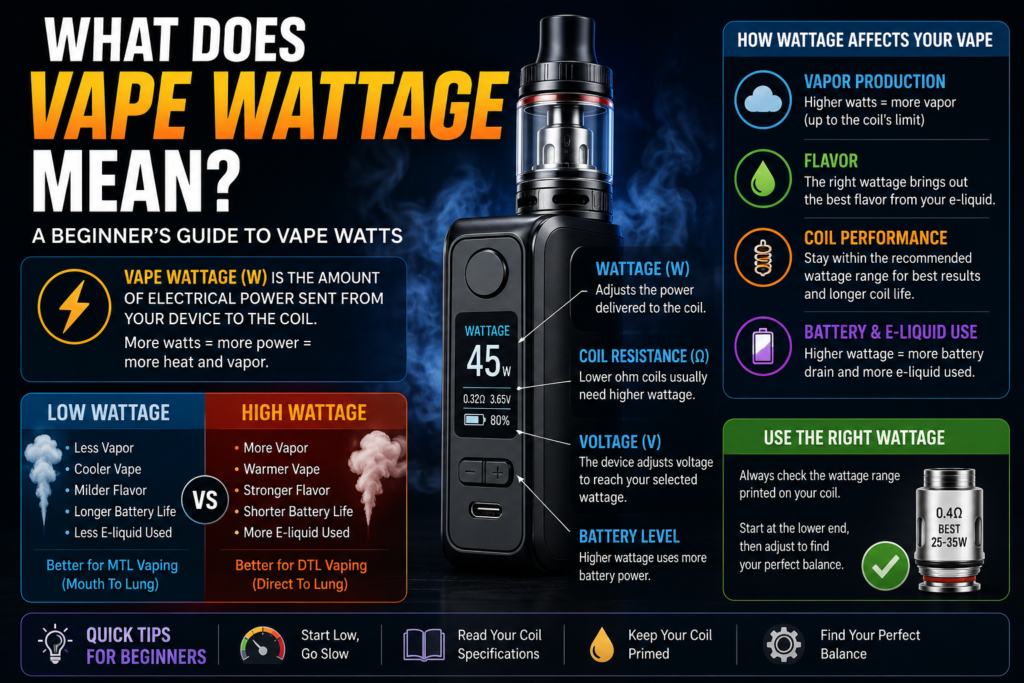
What Does Vape Wattage Mean? A Complete Beginner’s Guide
If you have ever looked at a vape device and wondered what “watts” or “wattage” means, you are not alone. Wattage is one of the most important settings on many vape devices, especially adjustable pod systems, vape pens, and box mods.
In simple terms, vape wattage controls how much electrical power the device sends to the coil. Changing the wattage can affect vapor production, temperature, flavor, battery consumption, and how quickly the coil uses e-liquid.
Understanding wattage can help users operate compatible devices more appropriately and avoid settings that may cause poor performance or damage to a coil.
What Is Vape Wattage?
Vape wattage is the amount of electrical power delivered to the heating coil. It is measured in watts (W).
When you press the fire button, the battery supplies electrical energy to the coil. The coil heats up, and that heat turns e-liquid into an aerosol.
Generally:
- Lower wattage produces less power and usually less heat.
- Higher wattage produces more power and usually more heat.
- Increasing wattage can increase vapor production.
- Higher wattage can also increase e-liquid and battery consumption.
The exact results depend on the device, coil resistance, airflow, e-liquid, and coil design.
Why Does Wattage Matter?
Wattage affects several aspects of the vaping experience.
Vapor Production
Higher power can cause the coil to heat more intensely, which may produce more aerosol.
However, simply increasing wattage is not always better. Every coil has an operating range, and exceeding the manufacturer’s recommended range can cause poor performance or damage.
Flavor
Wattage can also influence flavor.
A coil operating within its recommended range may provide the balance intended by its manufacturer. Too little power can result in weak vapor and muted flavor, while excessive power can overheat the coil and produce an unpleasant burnt taste.
Coil Performance
The coil is designed to operate within a particular power range.
For example, a coil may have a manufacturer’s recommended range such as 15–20W. Using it around that range is generally more appropriate than immediately setting the device far above the recommended maximum.
Always check the specifications printed on the coil or provided by the manufacturer.
Battery Consumption
Higher wattage generally requires more electrical power.
As a result, using a device at higher wattages can cause the battery to drain faster than using it at lower settings.
How Does Wattage Affect Temperature?
Wattage and temperature are closely related, but they are not exactly the same thing.
A higher power setting can cause the coil to heat more quickly and reach higher temperatures. However, actual coil temperature also depends on factors such as:
- Coil resistance
- Coil material
- E-liquid saturation
- Airflow
- Puff duration
- Device design
Some advanced vape devices include temperature-control modes, which work differently from simple wattage adjustment.
What Is the Difference Between Watts and Volts?
Watts and volts describe different electrical properties.
Voltage (V) refers to electrical potential, while wattage (W) refers to electrical power.
In vaping, the device’s electronics regulate the relationship between voltage, resistance, and power.
A commonly used electrical relationship is:
Power (watts) = Voltage² ÷ Resistance (ohms)
This means that changing voltage or coil resistance can affect the amount of power delivered to the coil.
Most modern regulated vape devices calculate these values automatically, so beginners generally do not need to perform the calculation themselves.
What Does Ohm Mean on a Vape Coil?
You may see another number printed on a vape coil, such as 0.6Ω, 0.8Ω, or 1.2Ω.
The ohm (Ω) value represents the electrical resistance of the coil.
Resistance influences how the coil responds to electrical power.
In general, lower-resistance coils are often designed for higher-power operation, while higher-resistance coils are commonly used at lower power. However, this is not a universal rule.
The safest approach is to follow the specific wattage range provided by the coil manufacturer.
Low Wattage vs High Wattage
Understanding the general differences can make vape settings easier to understand.
| Feature | Lower Wattage | Higher Wattage |
|---|---|---|
| Power | Lower | Higher |
| Coil heating | Gentler | More intense |
| Vapor production | Usually lower | Usually higher |
| Battery consumption | Usually lower | Usually higher |
| E-liquid consumption | Usually lower | Usually higher |
| Coil stress | Generally lower within specifications | Generally higher |
| Heat | Usually lower | Usually higher |
These are general tendencies rather than guarantees because devices and coils vary.
What Wattage Should a Beginner Use?
There is no single wattage that works for every vape.
The correct setting depends primarily on the coil installed in the device.
If your coil says 10–15W, for example, operating within that range is more appropriate than choosing a random higher setting.
For a new coil, starting near the lower end of the manufacturer’s recommended range can be a practical way to see how the device performs. You can then adjust gradually while staying within the specified range.
Why Should You Follow the Coil’s Wattage Range?
Manufacturers design coils for particular operating conditions.
The recommended wattage range takes into account the coil’s resistance, construction, wicking material, and intended performance.
Running a coil above its recommended range can cause:
- Excessive heat
- Burnt or unpleasant flavor
- Faster coil deterioration
- Excessive e-liquid consumption
- Dry or insufficiently saturated wicking
In contrast, running significantly below the recommended range may produce weak vapor or flavor.
What Happens If Wattage Is Too High?
Setting the wattage too high can make the coil heat faster and more intensely than intended.
One of the most recognizable signs is a burnt taste.
Other possible signs include:
- Harsh or unusually hot vapor
- Reduced coil lifespan
- Rapid e-liquid consumption
- Excessive heat from the device
- Dry hits
If this happens, stop using the device and check the coil’s recommended power range and the manufacturer’s instructions.
Buy from our store – silksroadsmarket.com
What Happens If Wattage Is Too Low?
Low wattage usually presents a different set of issues.
You may notice:
- Weak vapor production
- Muted flavor
- Slower heating
- An unsatisfying draw
If the coil has a recommended range, gradually adjusting the power within that range may improve performance.
Does Higher Wattage Mean Better Vaping?
Not necessarily.
Higher wattage does not automatically mean better flavor or a better experience.
The ideal setting depends on the coil and device.
A coil designed for low-power operation may perform poorly if you dramatically increase the wattage. Likewise, a high-power coil may not perform as intended at an extremely low setting.
Think of wattage as a matching setting, not a competition to reach the highest number.
How Does Wattage Affect Battery Life?
Battery life is another important consideration.
Higher wattage generally requires more power from the battery, so increasing the wattage can reduce the time between charges.
Battery performance also depends on:
- Battery capacity
- Device efficiency
- Coil resistance
- Puff duration
- Frequency of use
- Device design
If battery life is important, staying within the appropriate lower portion of a coil’s recommended range may reduce power consumption compared with consistently using the highest available setting.
How Does Wattage Affect E-Liquid Consumption?
Higher power can increase the amount of e-liquid converted into aerosol during each puff.
Therefore, users may notice that their e-liquid runs out faster when operating a compatible device at higher wattages.
The actual amount varies based on the device, coil, airflow, puff duration, and frequency of use.
Wattage and Airflow Work Together
Wattage is only one part of the equation.
Airflow also affects how a vape feels and performs.
More airflow can cool the coil and change the density and temperature of the aerosol. Less airflow can create a warmer and more concentrated draw.
The relationship between airflow and wattage depends on the specific device.
If you change the wattage, you may also need to consider how the airflow setting affects the overall experience.
Wattage and MTL vs DTL Vaping
Wattage can also vary depending on the type of vaping style a device is designed for.
MTL (mouth-to-lung) vaping involves drawing aerosol into the mouth before inhaling it into the lungs. Devices designed for MTL commonly operate at lower power levels.
DTL (direct-to-lung) vaping involves inhaling aerosol directly into the lungs. Some DTL devices and sub-ohm coils are designed for substantially higher wattage.
However, these are general categories. Always use the settings specified for the particular coil and device.
What Is Variable Wattage?
Variable wattage (VW) is a mode available on many regulated vape devices.
It allows the user to choose a specific wattage rather than operating at one fixed power level.
For example, a device might allow settings from 5W to 80W.
The device’s electronics then adjust the voltage supplied to the coil to achieve the selected power level.
Variable wattage can make it easier to fine-tune a compatible setup.
What Is Smart Wattage?
Some modern vape devices offer a smart wattage or similar automatic mode.
Depending on the manufacturer, the device may detect the installed coil and recommend or automatically select a suitable wattage.
This can be useful for beginners because it reduces the need to manually determine an appropriate starting setting.
The exact behavior varies by device, so users should consult the manufacturer’s instructions.
Common Vape Wattage Mistakes
New users sometimes make simple mistakes when adjusting power.
Setting the Wattage Too High
Choosing the maximum wattage available does not mean the coil will perform better.
Always check the coil specifications first.
Ignoring the Coil’s Recommended Range
The wattage range printed on the coil exists for a reason. Operating outside that range can lead to poor performance or coil problems.
Changing Wattage Too Quickly
Small adjustments make it easier to identify how a coil responds.
Large jumps can make it difficult to determine which setting provides the best performance.
Using a Nearly Dry Coil
A coil needs sufficient e-liquid saturation to operate properly.
Using a device when the wick is not adequately saturated can result in a dry or burnt hit, regardless of the wattage setting.
How to Find the Right Wattage
A simple approach is:
1: Identify the coil installed in your device.
2: Check the wattage range printed on the coil.
3: Read the manufacturer’s instructions if the range is not clearly visible.
4: Start toward the lower portion of the recommended range.
5: Make small adjustments while staying within the manufacturer’s specifications.
6: Pay attention to flavor, vapor production, heat, and coil performance.
If the device becomes unusually hot or the coil develops a burnt taste, stop and check the settings.
Frequently Asked Questions
What does W mean on a vape?
“W” stands for watts, which is the unit used to measure electrical power. On a vape device, the wattage setting controls the power delivered to the heating coil.
Is higher wattage better?
No. Higher wattage is not automatically better. The appropriate power depends on the coil and device. Always follow the manufacturer’s recommended wattage range.
Does higher wattage use more vape juice?
Generally, yes. Increasing power can increase aerosol production and therefore may increase e-liquid consumption.
Does higher wattage drain the battery faster?
Generally, yes. Higher power requires more energy, so battery life can decrease when using higher wattage settings.
Can the wrong wattage burn a coil?
Yes. Operating a coil at excessively high power can cause overheating and contribute to a burnt taste or shortened coil life.
What wattage should I use with my vape?
Use the wattage range specified for your particular coil. There is no universal wattage that works for every vape device.
What is the difference between wattage and voltage?
Voltage measures electrical potential, while wattage measures electrical power. Vape devices use these electrical properties together to control how much power reaches the coil.
Final Thoughts
So, what does vape wattage mean?
Simply put, wattage is the amount of electrical power delivered to a vape coil. It influences how quickly the coil heats, vapor production, flavor, e-liquid consumption, and battery usage.
The most important rule is not to assume that higher wattage is better. Use the wattage range recommended for your specific coil and device, make adjustments gradually, and follow the manufacturer’s safety instructions.
Understanding wattage becomes much easier once you know how it interacts with coil resistance, airflow, battery power, and e-liquid. With those basics in mind, you can better understand the settings on your device and avoid common wattage-related problems.